
Currently Empty: ₨0.00
0 Comments
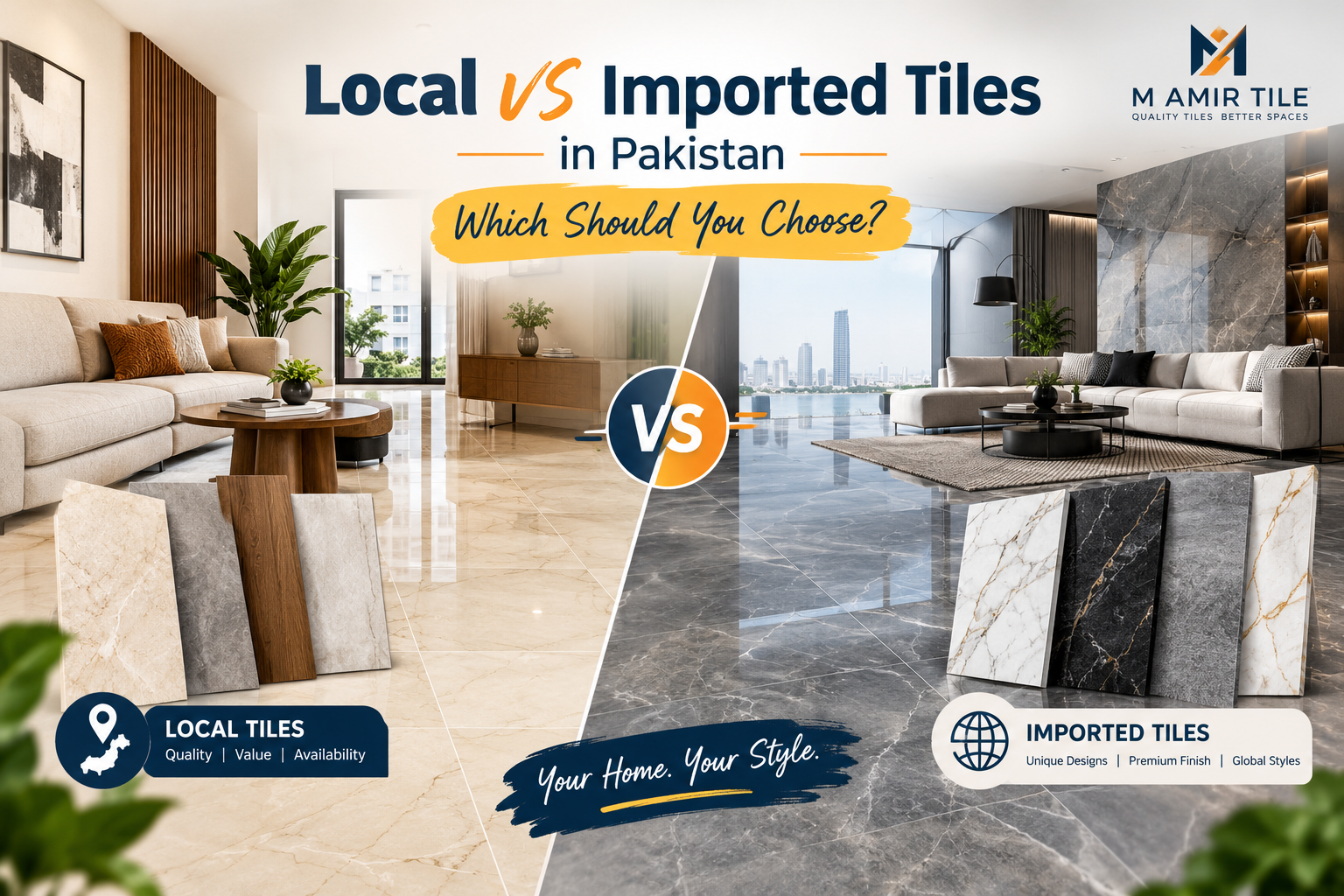
Choosing the right tiles for your home is an important decision. Whether you are building a new house, renovating a bathroom, upgrading your kitchen, or designing a modern living room, the tiles you select can affect your budget, durability, maintenance, and overall interior design.
One common question homeowners ask is: Are local tiles better than imported tiles in Pakistan?
The answer depends on your budget, design preferences, installation requirements, and the quality of the specific product. Local tiles can offer excellent value and practical designs, while imported tiles may provide distinctive finishes, premium collections, or specialized designs.
In this guide, we compare local vs imported tiles in Pakistan to help you choose the best option for your home. We will also explain tile quality, pricing factors, durability, maintenance, and what to check before purchasing tiles from a trusted supplier such as M Amir Tile.
What Are Local and Imported Tiles?
Before comparing prices and quality, it is important to understand the difference between locally manufactured tiles and imported tiles.
What Are Local Tiles in Pakistan?
Local tiles are manufactured within Pakistan. They are available in various sizes, colours, patterns, and finishes for residential and commercial projects.
Many Pakistani tile manufacturers offer options for floors, walls, bathrooms, kitchens, and exterior spaces. Depending on the manufacturer and product range, local tiles can provide modern designs at different price points.
Benefits of local tiles include:
- A wide selection of products for different budgets.
- Easier access to local suppliers and replacement stock, depending on availability.
- Convenient purchasing from local tile markets and showrooms.
- Designs suitable for contemporary and traditional Pakistani homes.
- Potentially lower transportation and import-related costs.
However, local tile quality can vary between manufacturers and product ranges. Therefore, buyers should check the actual product rather than judging quality by its country of origin alone.
What Are Imported Tiles?
Imported tiles are manufactured outside Pakistan and brought into the country for sale. Depending on the supplier, they may come from countries such as China, Spain, Italy, Iran, or other tile-producing regions.
Imported tiles cover a broad range of products, from budget-friendly ceramic tiles to premium porcelain tiles and designer collections.
Benefits of imported tiles may include:
- Unique colours, patterns, and decorative finishes.
- Specialized textures and contemporary designs.
- Access to particular sizes or collections not readily available locally.
- Premium design options for luxury interiors.
- A wider choice of international styles, depending on the importer.
Nevertheless, imported tiles are not automatically better than local tiles. Their quality depends on the manufacturer, material, production standards, and specific product specifications.
Local vs Imported Tiles in Pakistan: Key Differences
When comparing local vs imported tiles in Pakistan, consider more than appearance and price. The following table highlights the main differences.
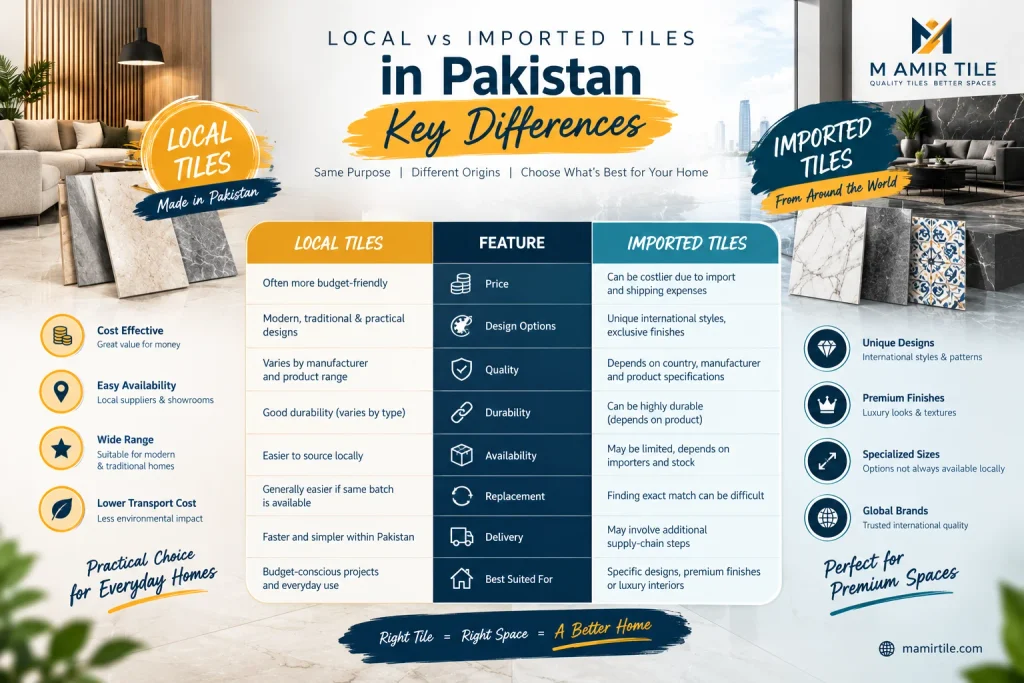
| Comparison Factor | Local Tiles | Imported Tiles |
|---|---|---|
| Price | Often more budget-friendly | Can cost more due to import-related expenses |
| Design options | Modern, traditional, and practical designs | May offer distinctive international styles |
| Quality | Varies by manufacturer and product | Varies by country, manufacturer, and product |
| Durability | Depends on material and specifications | Depends on material and specifications |
| Availability | May be easier to source locally | Depends on imports and supplier stock |
| Replacement | Potentially easier if the same batch remains available | Matching the original batch may be difficult |
| Delivery | Often more straightforward within Pakistan | May involve additional supply-chain considerations |
| Best suited for | Budget-conscious projects and everyday applications | Buyers seeking specific designs or premium finishes |
Quick answer: Local tiles are often a practical choice for homeowners seeking value and convenient availability. Imported tiles may be suitable for buyers who want a particular design, finish, or collection. In both cases, the product’s technical specifications matter more than the label.
1. Price Comparison: Local vs Imported Tiles in Pakistan
Price is one of the biggest factors when choosing tiles for a house. However, the cheapest tile is not always the most economical option in the long run.
Are Local Tiles Cheaper Than Imported Tiles?
Local tiles can be more affordable because they may avoid certain import duties, international shipping expenses, and currency-related costs associated with imported products.
As a result, homeowners can often find local options that suit different construction budgets. However, premium local tiles can also be expensive, while some imported tiles may be competitively priced.
Why Do Imported Tiles Cost More?
The price of imported tiles can be affected by several factors:
- International shipping and freight charges.
- Customs duties, taxes, and other applicable import expenses.
- Exchange-rate fluctuations.
- Manufacturer reputation and product specifications.
- Distributor margins and local transportation.
- Tile size, finish, material, and design complexity.
Therefore, compare the total installed cost, not just the price per square foot.
| Cost Factor | What to Check |
|---|---|
| Tile price | Cost per square foot or square metre |
| Wastage | Extra tiles required for cuts and breakage |
| Tile adhesive | Suitable adhesive and application costs |
| Labour | Installation rates and surface preparation |
| Transport | Delivery charges to your location |
| Maintenance | Cleaning requirements and replacement availability |
For example, a tile with a lower purchase price may require more cutting, careful installation, or specialized adhesive. Consequently, its final cost could be higher than expected.
Buying tip: Request a complete quotation that includes the tile rate, required quantity, delivery charges, and installation-related expenses.
2. Tile Quality and Durability: Which Is Better?
When comparing local and imported tiles, quality should be one of your main priorities. A tile’s country of origin alone does not determine its strength, water absorption, slip resistance, or suitability for a particular room.
What Determines Tile Quality?
Before purchasing any tile, check these factors:
- Material: Ceramic and porcelain tiles have different properties and applications.
- Water absorption: This is especially important for bathrooms, kitchens, and outdoor areas.
- Wear resistance: Floor tiles must suit the expected level of foot traffic.
- Slip resistance: Wet areas require suitable surface characteristics.
- Thickness and consistency: Check dimensions, edges, and visible defects.
- Surface finish: Polished, matte, textured, and other finishes have different practical considerations.
- Installation suitability: Confirm that the tile works with the intended surface and installation method.
Are Imported Tiles More Durable?
Not necessarily. A high-quality locally manufactured porcelain tile can outperform a lower-quality imported product in a particular application.
Similarly, a well-manufactured imported tile may offer excellent durability and finish. The important factors are its specifications, manufacturing quality, intended use, and correct installation.
For a fair comparison, ask the supplier for product specifications and, where available, technical data or test information.
3. Design and Appearance: Which Tiles Look Better?
The visual appearance of your tiles affects the overall style of your home. Fortunately, both local and imported tiles offer options for modern, classic, minimalist, and luxury interiors.
Local Tiles for Modern Pakistani Homes
Local tile collections may include:
- Marble-look tiles for living rooms and bedrooms.
- Neutral-coloured tiles for minimalist interiors.
- Wood-look tiles for warm and natural-looking spaces.
- Decorative wall tiles for kitchens and bathrooms.
- Practical floor tiles for everyday residential use.
These options can help homeowners create an attractive interior without exceeding their renovation budget.
Imported Tiles for Premium Interiors
Imported collections may be worth considering when you want a specific international design or finish.
Examples include distinctive marble patterns, large-format surfaces, decorative feature tiles, and specialized textures. However, availability depends on the brand and supplier, and similar styles may also be available from local manufacturers.
Design tip: Do not choose a tile only because it looks luxurious in a showroom. Check its colour and finish under your home’s lighting, and compare a physical sample with your furniture, wall colours, and room dimensions.
4. Which Tiles Are Best for Different Areas of Your Home?
The best tile depends on where you plan to install it. A beautiful tile that works well on a bedroom wall may not be suitable for a wet bathroom floor.
Best Tiles for Living Rooms
For living rooms, consider:
- Large-format tiles for a spacious appearance.
- Marble-look porcelain tiles for an elegant finish.
- Neutral colours that complement your furniture.
- Floor tiles suitable for regular foot traffic.
Both local and imported options can work well. Compare the finish, dimensions, durability, and overall cost before making a decision.
Best Tiles for Bathrooms
Bathrooms require particular attention to water exposure and slip resistance.
Look for:
- Floor tiles with suitable slip resistance for wet conditions.
- Wall tiles designed for the intended wall application.
- Surfaces that are easy to clean and maintain.
- Appropriate waterproofing and installation materials.
A glossy finish may look attractive on bathroom walls, but a glossy tile is not automatically a safe choice for a wet floor.
Best Tiles for Kitchens
Kitchen tiles should balance appearance with practicality.
Consider stain resistance, cleaning requirements, moisture exposure, and the intended installation area. For floors, choose a product designed for foot traffic. For backsplashes, prioritize a suitable wall finish that is easy to maintain.
Best Tiles for Outdoor Areas
Outdoor tiles need to withstand the conditions of the installation site.
Before purchasing, check suitability for rain, temperature changes, outdoor exposure, and slip resistance. Also, confirm that the tile is rated for the intended exterior application.
Do not assume that every imported or locally manufactured tile is suitable for outdoor use.
5. Availability and Replacement: An Important Buying Factor
Tile availability is often overlooked during construction. However, it becomes important if you need extra tiles after installation.
Local tiles may be easier to reorder from nearby suppliers, particularly when a product has an established supply chain. Imported tiles, on the other hand, may be available in limited quantities or through specific distributors.
Even so, availability varies by product and supplier.
Before placing an order, ask:
- Is the complete quantity available from the same batch?
- Can additional tiles be purchased later?
- Is the same design likely to remain in stock?
- What is the expected delivery time?
- Can the supplier reserve the required quantity?
Important: Always keep spare tiles after installation. Different production batches can have slight variations in shade, dimensions, or finish, making exact replacements difficult.
6. Environmental Impact: Local vs Imported Tiles
Transportation can contribute to the environmental footprint of imported tiles. However, transport is only one part of the picture.
Manufacturing methods, energy consumption, raw materials, product lifespan, packaging, and waste also affect a tile’s overall environmental impact.
Local tiles may reduce the distance travelled to your project, but local origin alone does not guarantee a more sustainable product. Likewise, an imported tile may have strong durability or environmental credentials.
If sustainability matters to you, ask manufacturers or suppliers about available environmental information, product lifespan, and responsible manufacturing practices.
7. How to Choose the Right Tiles for Your Budget
Making the right choice starts with a clear budget and an understanding of your home’s requirements.
Follow these steps before purchasing:
- Measure the area. Calculate the floor or wall area you need to cover.
- Set your budget. Include tiles, wastage, transport, adhesive, labour, and finishing.
- Choose the application. Identify whether the tile is for a floor, wall, bathroom, kitchen, or exterior.
- Compare specifications. Check material, water absorption, slip resistance, and wear suitability.
- Inspect samples. Look for defects, shade consistency, and finish quality.
- Confirm availability. Make sure enough tiles from a consistent batch are available.
- Compare suppliers. Review product details, delivery terms, and after-sales support.
- Keep spare tiles. Store extras safely for future repairs.
This approach helps you compare local and imported tiles on practical value rather than appearance alone.
8. Why Consider M Amir Tile for Your Tile Selection?
Choosing the right tiles becomes easier when you can compare different designs, finishes, and product options before making a purchase.
M Amir Tile offers a place to explore tile products and related building materials for your project. Whether you are renovating a bathroom, selecting floor tiles for a new home, or comparing products for a complete house, consider your design preferences alongside the technical requirements of each space.
You can explore available products and tile-related options at M Amir Tile.
Before purchasing, discuss your required tile size, intended application, quantity, and budget with the supplier. You can also explore the available tile bond products, including Case Bond, Hi Icon Tile Bond, and MAT Tile Bond, to identify a suitable option for your installation requirements.
Remember that tile adhesive should be selected according to the tile type, substrate, and manufacturer’s recommendations.
Planning a home renovation or new construction project? Explore M Amir Tile’s available collections and compare suitable options for your floors, walls, bathrooms, and kitchens.
9. Local vs Imported Tiles in Pakistan: Which Should You Choose?
There is no single answer for every home. Your ideal choice depends on the product, budget, design goals, and installation requirements.
Choose local tiles when:
- You want to explore budget-friendly options.
- You prefer convenient access to local suppliers.
- You need practical designs for everyday residential spaces.
- You want to simplify future purchasing, where stock remains available.
Consider imported tiles when:
- You are looking for a particular international design.
- You need a specialized finish or format.
- You have found a product with specifications that suit your project.
- The product’s quality and total cost fit your budget.
Most importantly, do not assume that all local tiles are cheap or that all imported tiles are premium. Compare the actual products, request specifications, and make a decision based on value.
Read more : Tiles Price in Pakistan: Complete Guide to Tile Rates by Size, Type and Quality
Frequently Asked Questions (FAQs)
Are local tiles better than imported tiles in Pakistan?
Local tiles can offer good value, convenient availability, and a wide range of designs. Imported tiles may provide particular styles or finishes. Neither category is automatically better; quality depends on the specific product and its intended use.
Are imported tiles more expensive than local tiles?
Imported tiles can cost more because of shipping, import expenses, exchange rates, and distributor margins. However, prices vary by product, size, material, and brand. Always compare the complete project cost.
Which tiles are best for a house in Pakistan?
The best tiles depend on the room, budget, and usage. Porcelain tiles may be suitable for many residential floors, while ceramic tiles are commonly used for walls and selected floor applications. For bathrooms and outdoor areas, check water exposure and slip resistance before buying.
Where can I explore tile options in Pakistan?
You can explore available products and tile-related materials through M Amir Tile. Compare designs, sizes, product specifications, availability, and prices before choosing the right option for your project.
Final Verdict
When comparing local vs imported tiles in Pakistan, the smartest decision is to focus on quality, suitability, price, design, and long-term value.
Local tiles can be an excellent choice for practical home construction and renovation, while imported tiles may suit projects that require specific designs or finishes. However, neither option should be selected on origin alone.
Compare the products carefully, confirm their technical specifications, and calculate the full installation cost before purchasing.
For your next project, explore the available options at M Amir Tile and choose tiles that suit your home, your budget, and the way you live.